
Since its first plasma in 2002, SUNIST has produced roughly 100,000 discharges and has been used to study equilibrium reconstruction, heating and current drive, MHD stability, turbulence and transport, fuelling, wall conditioning and diagnostics. A selection of the resulting research is summarised below.
3D eddy currents and equilibrium reconstruction
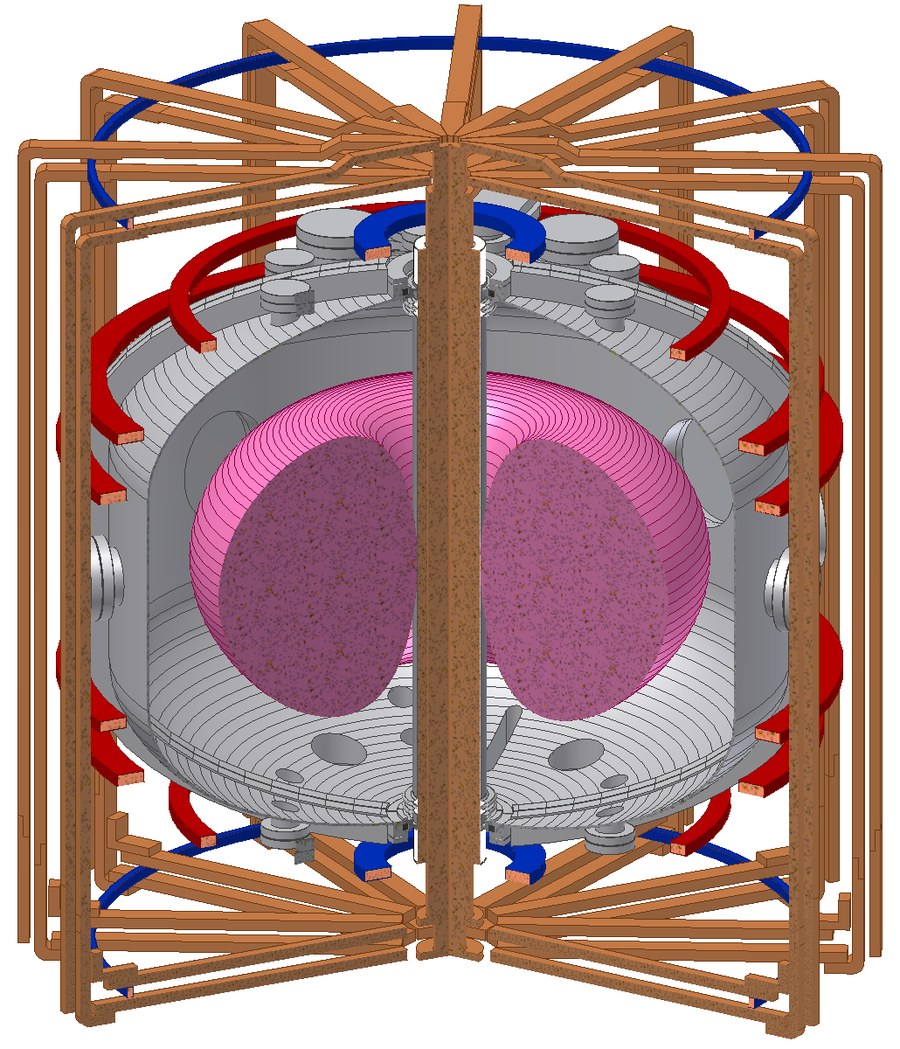
To save Ohmic flux, the SUNIST vacuum vessel is split by a three-dimensional Viton seal. The gap changes the loop-voltage evolution and produces eddy currents that flow in three dimensions, rather than axisymmetrically — an effect that was verified experimentally with an orthogonal magnetic-probe array installed near the slit.
Magnetic measurements are corrected by response functions so that the eddy-current contribution can be separated accurately. Magnetic surfaces can then be reconstructed from the very beginning of a discharge, even at ramp rates of about 30 MA/s where the eddy-current effect is large.
Selected papers: “A research program of spherical tokamak in China” (2002, doi:10.1088/1009-0630/4/4/003); “Measurement of eddy-current distribution in the vacuum vessel…” (2015, doi:10.1063/1.4927682); “Determination of eddy current response with magnetic measurements” (2017, doi:10.1063/1.5002190).
Starting, driving and heating the plasma
Electron-cyclotron start-up
SUNIST studied start-up with 2.45 GHz electron-cyclotron waves. Because of the low frequency, spikes in plasma current and density are widely observed at the beginning of discharges — an effect caused by the long wavelength and the evanescent field. Simulations of EC start-up were compared with experimental observations.
Alfvén wave current drive
Alfvén-wave antennas operating at 0.4–1 MHz were installed inside the vacuum vessel. Coupling was difficult and was measured in detail; high-quality boron-nitride plates for the antennas were lent by PPPL.
Electron-Bernstein wave heating
Ohmic plasmas on SUNIST are strongly over-dense (ne > 5.8×10¹⁸ m-3, well above the 2.45 GHz cutoff of about 7.4×10¹⁶ m-3), so electron-Bernstein wave mode conversion is used instead. A 2.45 GHz, 30 kW system works in FX–B mode; comprehensive estimation gives a conversion ratio of 62%. Wave energy is mainly deposited at the plasma periphery, making core heating difficult.
Power supply development
Heating and current drive go together with magnet power-supply engineering: a low-noise buck-converter supply for current regulation, an Ohmic-field supply based on a modified IGBT H-bridge, double-swing operation at ±10 kA and current feedback on the vertical field.
Selected papers: doi:10.1088/0029-5515/51/6/063021 · doi:10.1088/1009-0630/13/1/07 · doi:10.1016/j.fusengdes.2008.12.051 · doi:10.1016/j.fusengdes.2015.05.047 · doi:10.1063/1.5038820
Reconnection events, disruptions and tearing modes
High-frequency (above 200 kHz) magnetic perturbations are found in both internal reconnection events (IREs) and minor disruptions. Only the minor disruptions exhibit Alfvénic properties, and toroidal Alfvén eigenmodes were observed during them — raising the question of whether runaway electrons are involved.
During current ramp-up at rates up to 30 MA/s, tearing modes are often excited. An internal radial magnetic-probe array measured their temporal and spatial structure, and their effect on confinement was studied.
Selected papers: “Observation of toroidal Alfvén eigenmodes during minor disruptions in ohmic plasmas” (2016, doi:10.1063/1.4973230); “Experimental study of the tearing mode instability during the current ramp up stage in SUNIST” (2018, doi:10.1088/1741-4326/aadf98).
Fluctuations, energy transfer and a core quasi-coherent mode
Edge plasma electrostatic fluctuations and anomalous transport have been characterised with Langmuir probe arrays, including movable multi-probe systems for boundary measurements. The nonlinear interaction and energy transfer between density and magnetic fluctuations have been measured directly, and nonlinear energy cascading has been studied during internal reconnection events.
In the core plasma a quasi-coherent mode has been identified and characterised.
Selected papers: doi:10.1088/0741-3335/47/1/001 · doi:10.1063/1.4886425 · doi:10.1063/1.4977450 · doi:10.1088/2058-6272/ac85a3 · doi:10.1088/0256-307X/34/2/025201
Measuring a small, fast plasma
Magnetic probe arrays
Thin high-frequency and high-precision magnetic probe arrays, including an internal radial array and an orthogonal array near the vessel slit for 3D eddy-current studies.
Microwave interferometer
A five-channel 105 GHz interferometer with 0.5 µs response and 1×10¹⁵ m-2 resolution, used for density profiles and to measure density fluctuations caused by Alfvén waves.
Radiation diagnostics
Modular bolometric and soft X-ray diagnostics, together with hard X-ray measurements, have been developed for plasma current ramp-up and ramp-down research.
Probes and spectroscopy
Triple Langmuir probe arrays for mode-conversion studies, a reciprocating magnetic thrust probe (up to 20 m/s), a projectile probe, fast cameras and Doppler-broadening measurements.
Selected papers: doi:10.1063/5.0043631 · doi:10.1063/5.0043678 · doi:10.1063/1.5038085 · doi:10.1063/1.5038852 · doi:10.1063/5.0043667
Controlling the discharge
Discharge repeatability improves when discharges start from a uniform pressure profile, about 80 ms after the end of gas puffing. Gas-puffing performance for Ohmic discharges has been analysed in this light.
A high-field-side SMBI system injects gas with a Laval nozzle at about 1500 m/s, with 1 ms turn-on and a repeat interval below 3 ms. The density profile peaks shortly after injection. A compact mid-plane high-field-side injector is also under development.
Wall conditioning uses molybdenum limiters, baking below 373 K, glow discharge in hydrogen and helium, and siliconisation (tested before 2008).
Selected papers: doi:10.1088/1009-0630/16/8/03 · high-field-side SMBI patent CN110701319.
Selected publications
Refereed papers from the SUNIST programme cited on this page (metadata from Crossref). The list is not exhaustive.
- Quasi-coherent mode in core plasma of SUNIST spherical tokamak doi:10.1088/2058-6272/ac85a3
- Development of a thin high-frequency and high-precision magnetic probe array in Sino-United Spherical Tokamak doi:10.1063/5.0043631
- Implementation and data processing of a five-channel microwave interferometer with high temporal resolution and low noise on Sino-UNIted Spherical Tokamak doi:10.1063/5.0043667
- Modular bolometric/soft x-ray diagnostic in Sino-UNIted Spherical Tokamak doi:10.1063/5.0043678
- A low noise power supply based on buck converter for current regulation in an inductive load doi:10.1063/1.5038820
- Development of a triple probe array for mode conversion study of electron cyclotron wave doi:10.1063/1.5038852
- Experimental study of the tearing mode instability during the current ramp up stage in Sino-United Spherical Tokamak doi:10.1088/1741-4326/aadf98
- Radiation diagnostics for plasma current ramp-up and ramp-down research doi:10.1063/1.5038085
- Determination of eddy current response with magnetic measurements doi:10.1063/1.5002190
- Experimental measurements of energy transfer and nonlinear interaction in turbulence at the sino-united spherical tokamak doi:10.1063/1.4977450
- Nonlinear Energy Cascading in Turbulence during the Internal Reconnection Event at the Sino-United Spherical Tokamak doi:10.1088/0256-307X/34/2/025201
- Observation of toroidal Alfvén eigenmodes during minor disruptions in ohmic plasmas doi:10.1063/1.4973230
- An ohmic field power supply based on a modified IGBT H-bridge for Sino-UNIted Spherical Tokamak doi:10.1016/j.fusengdes.2015.05.047
- Measurement of eddy-current distribution in the vacuum vessel of the Sino-UNIted Spherical Tokamak doi:10.1063/1.4927682
- Analysis of the Gas Puffing Performance for Improving the Repeatability of Ohmic Discharges in the SUNIST Spherical Tokamak doi:10.1088/1009-0630/16/8/03
- Movable multi-probes for plasma boundary measurement in sino-united spherical tokamak doi:10.1063/1.4886425
- Simulation of ECR Startup and Comparison with Experimental Observations in SUNIST doi:10.1088/1009-0630/13/1/07
- Transient process of a spherical tokamak plasma startup by electron cyclotron waves doi:10.1088/0029-5515/51/6/063021
- Analysis and design of the Alfven wave antenna system for the SUNIST spherical tokamak doi:10.1016/j.fusengdes.2008.12.051
- Edge plasma electrostatic fluctuation and anomalous transport characteristics in the Sino-united spherical tokamak doi:10.1088/0741-3335/47/1/001
- A Research Program of Spherical Tokamak in China doi:10.1088/1009-0630/4/4/003
Twenty years of SUNIST research
A review series in eight chapters — the device, the plasma physics and the diagnostics, with figures and equations from the original manuscript.
Work with us
The laboratory welcomes collaboration, student projects and academic visits. Write to us to discuss ideas for experiments, diagnostics or joint work.