
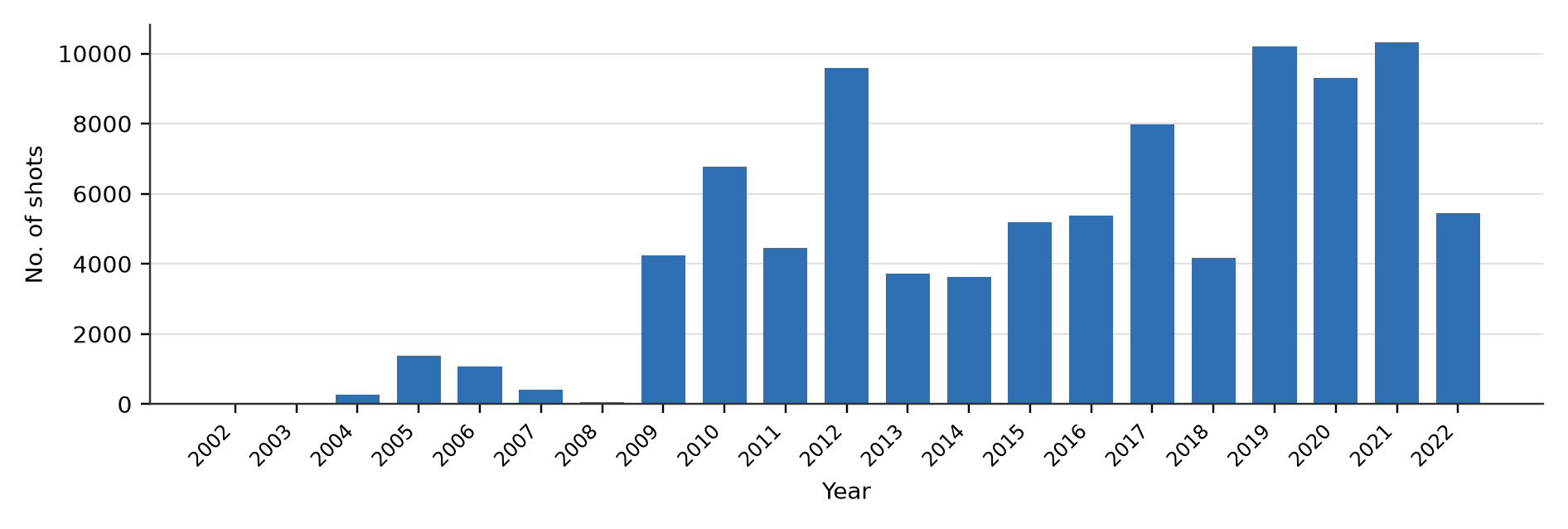
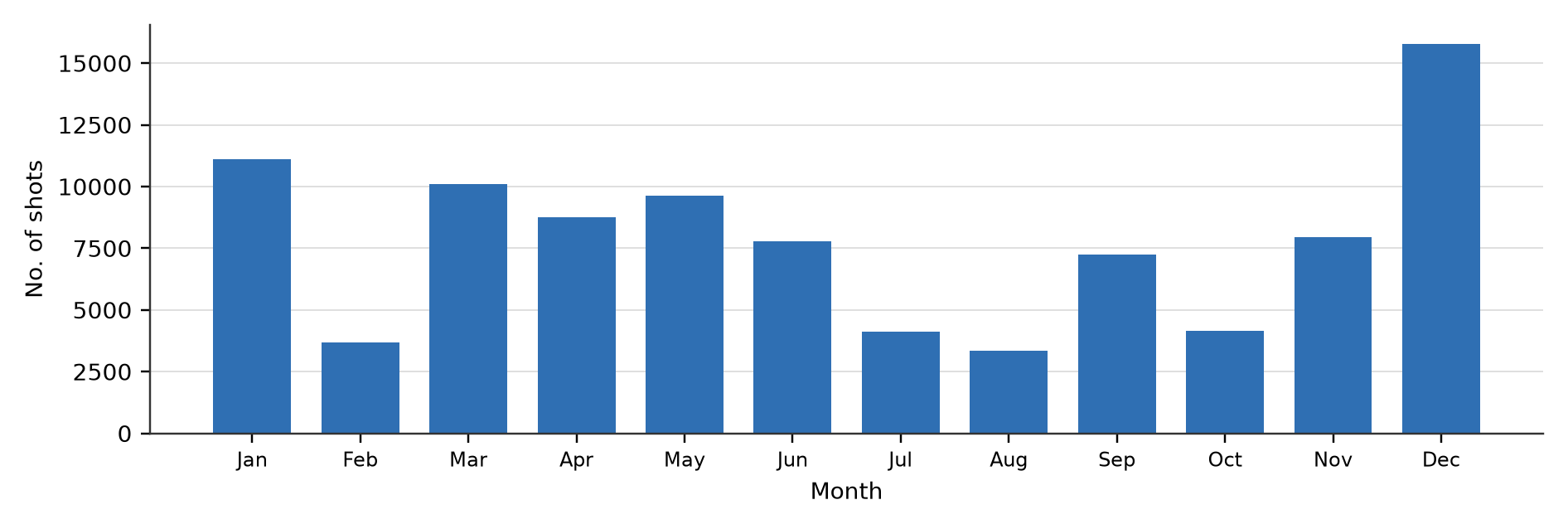
As evident from the figure, the annual shot count exceeded 3000 shots from 2009 onwards, with a peak of over 10,000 shots in some years. Analysing the monthly distribution (Fig. 2 bottom), we find SUNIST operations closely resemble general work schedules in China. This contrasts conventional tokamaks which often show strong seasonal trends. The fast maintenance turnaround enables rapid restoration of experiments on SUNIST. The months with fewest shots are February (Chinese New Year), August (summer vacation), and October (National Day holidays and conference seasons). December sees the highest activity, as research projects rush to complete targeted milestones before year-end.
Over its 20 years of operation, the main research thrusts on SUNIST can be summarized as follows: Firstly, investigations targeted at the compact center-post design unique to spherical tokamaks were performed, including device engineering, 3D eddy current effects, equilibrium reconstruction at high ramp-up rate, and the ubiquitous challenges of non-inductive startup and current ramp-up under the severe flux limitations. Secondly, continual upgrade campaigns were carried out to enhance SUNIST's plasma performance, representing a crucial mission throughout the two decades. Thirdly, dedicated studies leveraged the high-density low-field attributes of the SUNIST plasma. Research on O-X-B mode conversion and electron Bernstein wave heating were undertaken owing to the high dielectric constant of ST plasmas. The strong shaping and toroidal effects drove experiments on internal reconnection events, toroidal Alfvén eigenmodes, rapid current ramps enabled by low inductance, and tearing instabilities. General tokamak physics such as turbulence and transport were also investigated. Last but not least, the development of advanced diagnostics with unique capabilities constituted an important part of the SUNIST research program, which will also be highlighted in this review.
The diverse and comprehensive scientific program carried out on SUNIST over 20 years significantly expanded the understanding of spherical tokamak physics and engineering. The knowledge gained will provide valuable guidance on the design and operation of next-generation ST devices.