
The physics resulting from the strong shaping effects in SUNIST plasmas were studied.
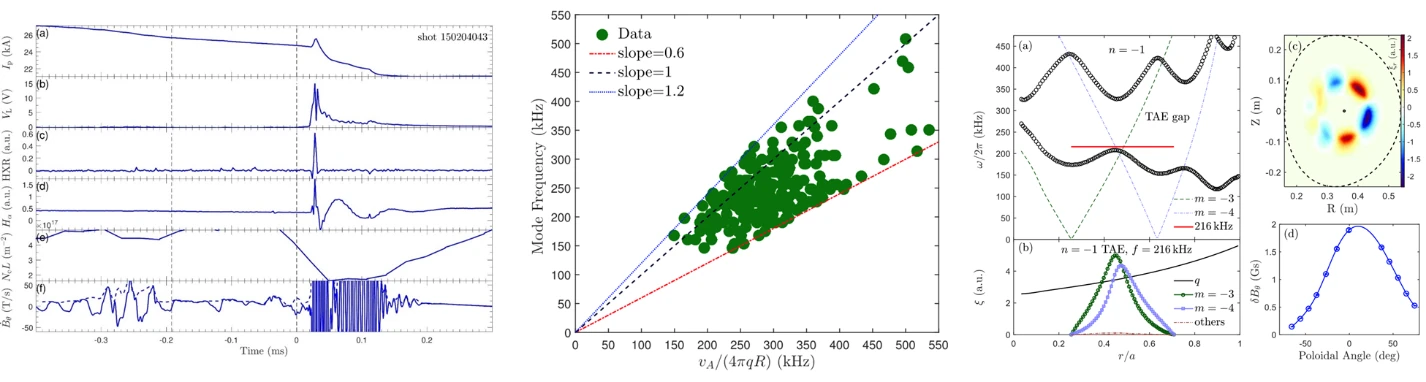
Spherical tokamaks rarely undergo disruptions, but small-scale internal reconnection events and minor disruptions are common. Using high-frequency magnetic probe arrays, we discovered intense fluctuations above 200 kHz closely associated with the reconnection dynamics. Detailed mode analysis, facilitated by the extensive coverage of the probe system, revealed these high-frequency perturbations exhibit an Alfvén eigenmode structure during minor disruptions. The measured features point to a possible toroidal Alfvén eigenmode[9] driven by trapped energetic electrons produced by the magnetic topology change, as shown in Fig. 13.
The low inductance of SUNIST plasmas also readily facilitates the excitation of fast-growing tearing modes, with ramp-up rates exceeding . To investigate their behavior, an internal array of Mirnov coils was developed. Inserted directly into the plasma, excellent spatial resolution of the tearing mode structure was achieved[10]. As evident in the figure, a clear phase reversal surface corresponding to a magnetic island was observed after mode onset. Thus, the time evolution of the current sheet could be reconstructed from the data (Fig. 14).
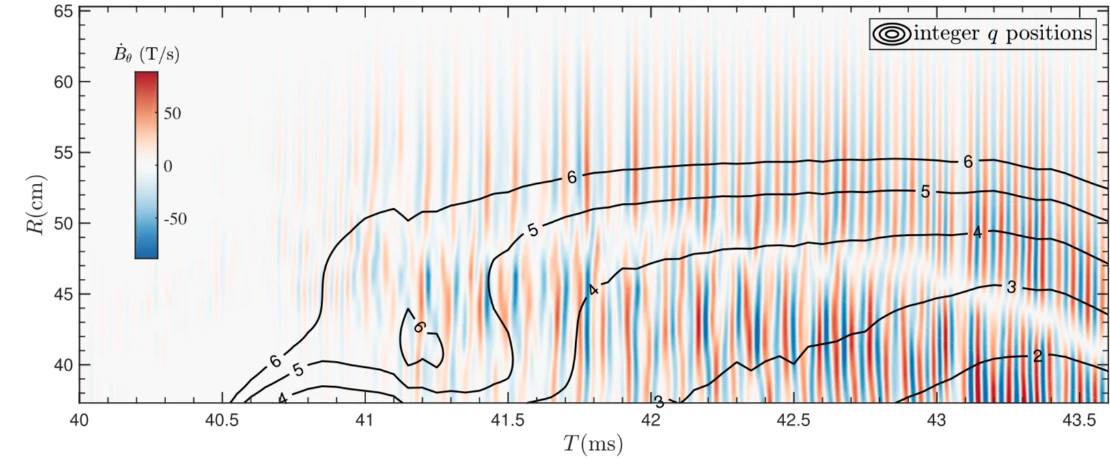
Parametric scans of mode amplitude and location were performed to study their impact on confinement. The critical factor was determined to be the radial position - external modes severely degraded confinement, while central modes had limited effects. These results quantify the importance of tearing stabilization for small, shaped ST plasmas.