
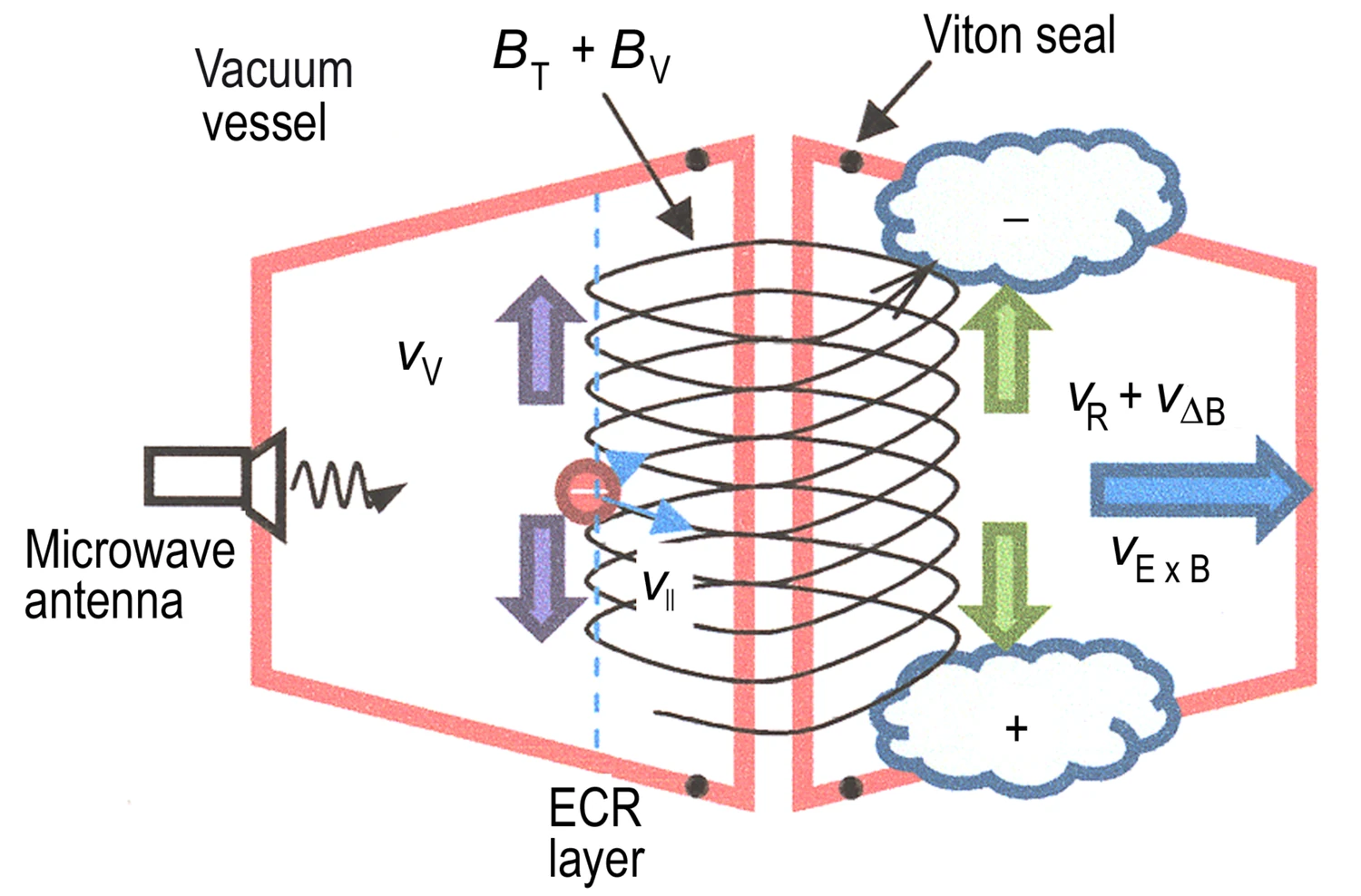
The non-inductive startup and current drive were important research topics on SUNIST. For startup, electron cyclotron resonance heating (ECRH) was adopted as a flexible non-inductive means. Given the low toroidal field and available RF sources, a magnetron with power was implemented as the microwave source.
Through experiments, we discovered a ubiquitous phenomenon in low-field, low-frequency ECRH startup - the appearance of density peaks. This effect has been widely reported in other STs with low toroidal field. On SUNIST, detailed parameter scans varying the toroidal field, vertical field, and RF power revealed the density peaking can be explained by a simple particle balance model (Fig. 11) accounting for ionization and cross-field diffusion. The strong evanescent field caused by long wavelengths of low-frequency microwaves are the typical causes[6][7].
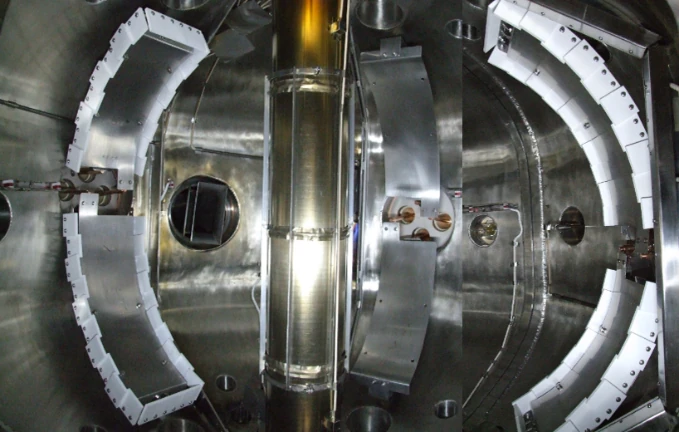
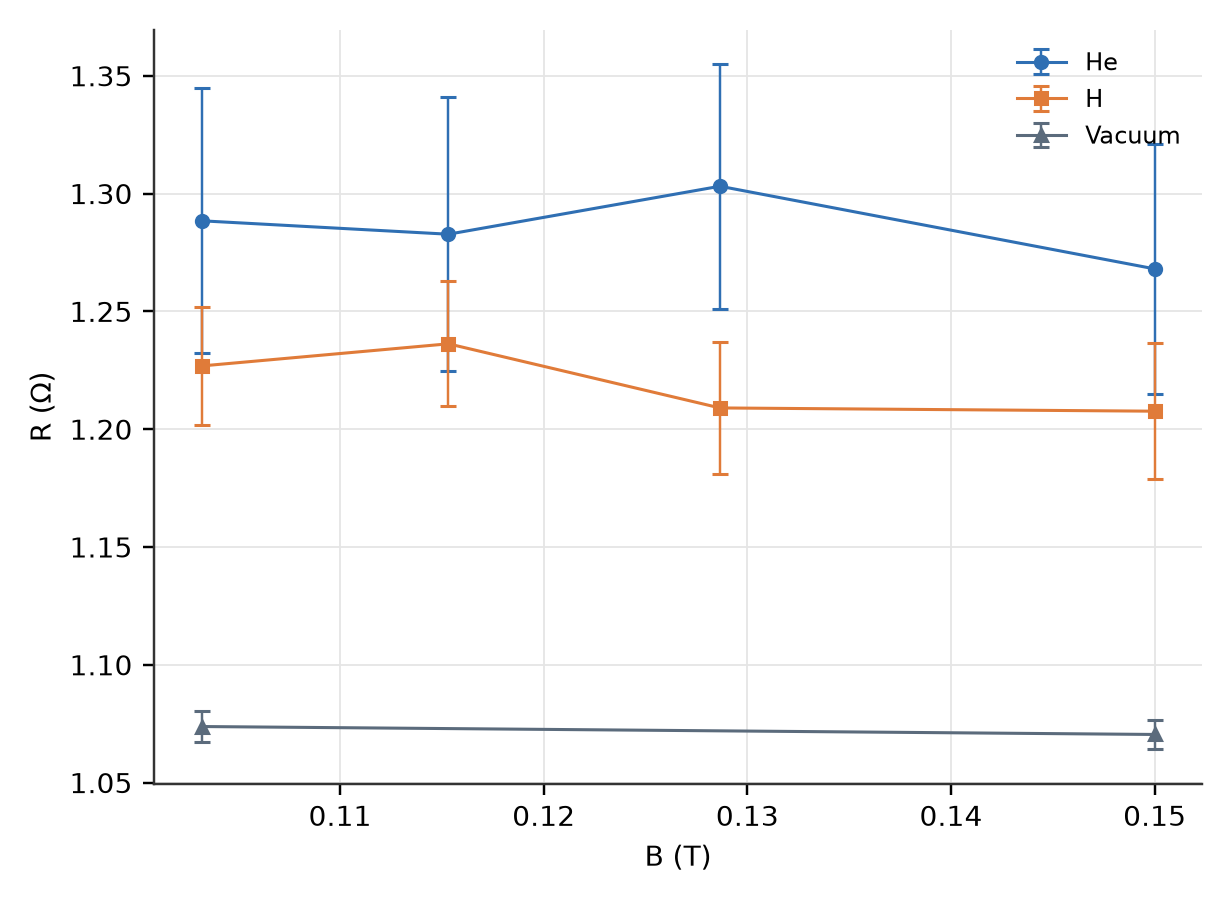
Besides ECRH, Alfvén wave current drive was also attempted. Compatible antenna and RF systems at were installed for SUNIST, along with boron nitride limiters[8]. However, experiments found poor coupling between such low-frequency waves and the plasma, failing to effectively transfer RF power for current drive. Only antenna loading effects were measured.
Owing to the high density and low field of SUNIST plasmas, direct core penetration of the 2.45 GHz electron cyclotron waves was difficult. Thus, research focused on studying the O-X-B mode conversion to electron Bernstein waves (EBW). This was investigated in ohmic discharges, where the typical density exceeded 6×10¹⁸ m-3, far above the 2.45 GHz cutoff around 7.4×10¹⁶ m-3. Multi-faceted analyses, including edge probes, full-wave modeling, and a quad-ridged horn antenna for polarization measurements, collectively indicated a mode conversion efficiency to EBW of 62% with proper injection geometry.
However, effective core electron heating remained elusive. 30 kW of 2.45 GHz microwaves injected in FX-B geometry were found to mainly drive parametric instabilities generating suprathermal electrons, which absorbed the RF power at the low-density edge. Bulk heating of the expected core plasma was not observed.